Why I spent 10th grade online by Sophia Pink

One of the authors that I love to read is Daniel Pink. It is fun to be able to be able to follow someone whose work you enjoy. Not just when they write a new book, but when they post a blog, podcast, or yes when they tweet. Recently, Dan tweeted this article about his daughter, Sophia. I have enjoyed watching a number of videos she has created. I really enjoyed this very level-headed look at online learning.

http://www.washingtonpost.com/opinions/why-i-spent-10th-grade-online/2013/08/22/f2001640-ed8a-11e2-bed3-b9b6fe264871_story.html

New School Year!!!

Welcome back!

This is an interesting cartoon and in a sense will be what this year’s blog will be about: the impact of technology on education. This year I will be delving further into technology not only in the classroom, but in our lives as learners. Looking forward to your comments, questions, and anything that you are willing to share.

What is the first thing that comes to mind when you look at the cartoon above?

One Man’s Dream: Build a School in the Cloud

There are many conversations going on about the future of education. Here is a man with a plan! This is an amazing, thought-provoking talk by Sugata Mitra on his dream of building a school in the sky.

One of my favourite quotes: “That’s the first time, as a teacher, that I had ever heard the word ‘teach ourselves’ said so casually.”

I would love to hear your comments. Enjoy!

What Success Really Looks Like!

Paulette Vermette suggested this graphic on “What Success Really Looks LIke”. Paulette is a balcony person; someone who continually uplifts other people! Thank you Paulette!

One of the most interesting aspects of this diagram is that all the fun , learning, growth, and enjoyment (and frustration) comes out of the squiggly part. Life is funny like that!

Knowledge as a Tool

“Are you using knowledge, or is knowledge using you?” This thought-provoking question was directed to him by don Miguel Ruiz Jr.‘s grandmother. It ended up, twenty years later, being the basis of his book, The Five Levels of Attachment. In it he explains that as our level of attachment to a belief or idea increases “who we are” becomes directly related to “what we know”.

In a number of recent posts, I have discussed the value of tools: mentors and coaches, books, videos and audios, and so on. However, there is a danger that we become ‘attached’ to these tools and the information they provide. As don Miguel Ruiz Jr. puts it: “who we are” becomes directly related to ‘what we know’.

In the introduction, he tells the following story that really hits home:

“Though she spoke no English, my grandmother gave sermons and lectures across the country. My apprenticeship began with translating my grandmother’s lectures from Spanish to English. For many years, I awkwardly stumbled over her words, and my grandmother would just look at me and laugh.

One day she asked me if I knew why I stumbled. I had all sorts of answers: you are speaking too quickly, you don’t give me a chance to catch up, some words don’t have a direct translation…She just looked at me silently for a few moments and then asked, ‘Are you using knowledge, or is knowledge using you?’

I looked at her blankly. She continued, ‘When you translate, you try to express my words through what you already know, what you think is true. You do not hear me; you hear yourself. If you are looking through life and translating it as it goes along, you will miss out on living it. But if you learn to listen to life, you will always be able to express the words as they come. Your knowledge has to become a tool you will use to guide you through life but that can also be put aside. Do not let knowledge translate everything you experience.’

I nodded in response, but it didn’t dawn on me until many years later what my grandmother was truly talking about. Throughout life, we constantly narrate, or commentate on, everything we do, say, see, touch, smell, taste, and hear. As natural storytellers, we continuously keep the plot moving forward, sometimes missing millions of subplots that are developing on their own. It is like taking a sip of wine and saying, ‘It’s a bit dry; it has definitely aged well, but I can taste the bark. I’ve had better.’ Instead of simply experiencing the joy and flavours of the wine, we are analyzing the flavour, trying to break it down and fit it into a context and language we already know. In doing this, we miss out on much of the actual experience.”

An absolutely wonderful book, with a great message for me! Listen to life!
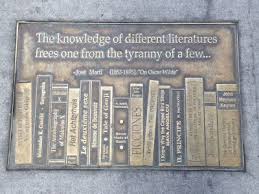
More Quotes from English 9 + 10

“A sensible man watches for problems ahead and prepares to meet them. The simpleton never looks and suffers the consequences.” Proverbs 27:12

“You can’t always control circumstances, but you can control your own thoughts.”Charles Popplestone

“Love is something you do for someone else, not something you do for yourself.” The 5 Love Languages, Gary Chapman

“A hungry ego is a mean ego. To make a happy ego you need to feed it with respect. People without respect have a mean ego.”  How to Have Confidence and Power in Dealing with People, Les Giblin

“Gentle words cause life and health; griping brings discouragement.” Proverb 15.4

What are some of yours?


Non-Fiction Book Study Grade 9 + 10 – Quotes

As I mentioned a couple of weeks ago, the Grade 9 + 10 English class are reading a non-fiction book (or two). There has been some great sharing, as well as a little jockeying to find the right book, which is part of this learning experience.

The students are exploring various ways to internalize some of the ideas and concepts from the books we are reading. So in the past week we have started a quote wall, where students can share some of the best quotes from their books.

Here are a few:

“If you can dream it, you can do it.” Walt Disney

“Imagination is more important than knowledge.” Albert Einstein

“Without conflict there is no growth, and the most challenging conflict is within ourselves.” Brio in the Ant and the Elephan

t”The law of nature is: Do the thing, and you shall have the ^power; but they who do not the thing have not the power.”  Ralph Waldo Emerson

“Repeat anything often enough and it will start to become you.” Tom Hopkins

“There is a tide in the affairs of men, which taken at the flood, leads on to fortune; omitted, all the voyage of their lifeis bound in shallows and in miseries.” William Shakespeare

“Small actions compound over time. That means they grow in size and impact and lead to much bigger things.” Success for Teens

The Value of Tools – Preparing for the Unknown

In the Grade 9 + 10 English class, we have discussed how to prepare for the unknown. At least, we have asked the question and started to explore that idea. This theme on “The Value of Tools” is part of the answer. It is about building capital before you need it. The capital being: education; seeking a wide variety of activities and experiences; developing a network of friends, mentors, and trusted advisors; building a library of books, audio and video recordings, blogs, podcasts that encourage, inspire, challenge, and help you to grow.

Meg Jay, a clinical psychologist, explores this very idea, of preparing for the unknown, in a TED Talk (she also introduces the idea of identity capital). While this talk is aimed at the twentysomethings, it is a great talk for anyone who is a young adult or has one in their life. A sample of a great piece of wisdom from the talk is the following quote: “the best time to work on Alex’s marriage is before she has one.”

Check out the video below in which she gives 3 pieces of advice that are invaluable to any young adult and, really, to anyone:

The Value of Tools TED Talks

TED: Ideas worth spreading, has since 1990, done exactly that. TED (Technology, Entertainment, Design) brings together thought-leaders from various fields to give talks that are usually 20 minutes or less. In 2006, the talks were put online for free viewing. By 2009 the various talks had been viewed 50 million times; by 2011, 500 million times; on Tuesday, November 13, 2012, they had been viewed 1 billion times. They are currently about 1500 talks available.

TED’s mission statement is: We believe passionately in the power of ideas to change attitudes, lives and ultimately, the world. So we’re building here a clearinghouse that offers free knowledge and inspiration from the world’s most inspired thinkers, and also a community of curious souls to engage with ideas and each other.

On Friday, May 17, our English class watched a TED Talk by Dan Ariely on “What makes us feel good about our work”. It is an amazing talk that highlights how easily we can be motivated, but also how easy it is to be de-motivated. Students answered a few questions before the 20-minute video, and then were asked to share what they learned after.

The video is below. Enjoy!

http://www.ted.com/talks/dan_ariely_what_makes_us_feel_good_about_our_work.html

The Value of Tools – Learning from Others

Did Henri learn from Jacques?

In the logging contest (last post), Henri was completely convinced that Jacques cheated somehow, because he took four, ten-minute breaks, while he worked hard non-stop. Jacques explained, that he did not rest during the breaks, but used the time to sharpen his axe.

The real question is, “Did Henri learn from the experience and wisdom of someone else?” Or did he just keep doing what he always did in the past?

How do we prepare for the unknown? How do we help our children (students) prepare for a future which is changing rapidly and in many unpredictable directions?

One of the ways is to learn from the Jacques’s of the world. Often our first “Jacques” are usually our parents. As parents do we share our experiences – good and bad – to help our children understand. Do we let the see that we have made mistakes and that we can all learn from those.

Do we seek out mentors and advisors in various areas of life: relationships, finance, health and fitness, faith, and yes, do you know a good mechanic? These are relationships built over time with people that you trust. People who are knowledgeable and have your best interest at heart. Communication today makes it easier to connect, to share information, and stay connected. Remember as in any relationship, face to face time is always invaluable.

When is a good time to start?

“The best time to plant an oak tree was twenty years ago. The second best time is now.” Author Unknown